
Wholesale, Natural & Lab-Grown
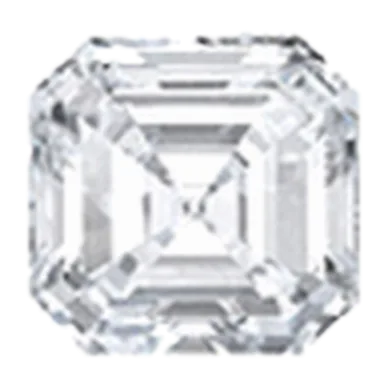
Wholesale Asscher Cut Diamonds
Natural and lab-grown are two separate lines here, never mixed on one certificate or one price list.
Square outline, cut corners, and concentric steps running down to a small table. An asscher is what happens when you take an emerald cut, square it off, and deepen it. Look straight down into one and you see the windmill: four dark arms radiating from the center out to the corners.
It is a specialist's shape and the client who wants one is rarely talked into something else. Art deco restoration, bezel work, and anyone who finds brilliants too busy all end up here. That narrow, committed demand is precisely why it is worth stocking at wholesale, because the buyer arrives already sold on the shape.
Our asscher position is unusual in one way worth flagging: more than one in four asschers we carry is natural. Over 200 natural and over 500 lab-grown are available now. Very few fancy shapes on our floor are that evenly weighted between the two lines.
Buying Asscher Diamonds Wholesale
Clarity has nowhere to hide. The steps are open and the table sits directly over the center of the stone, so an inclusion under the table is visible without a loupe. VS2 is a sensible floor for anything over a carat, and the location on the plot matters as much as the letter. Push a grade higher than you would for a brilliant of the same size.
Judge the windmill. In a well cut asscher the four arms are even, meet cleanly at the center, and stay symmetrical as the stone tilts. Crooked or mismatched arms mean the steps are not parallel, which no grade will tell you outright. This is the single fastest quality read in the shape.
Asschers face up small. The design puts real depth under the table, so a two carat asscher spreads closer to a smaller round. Set expectations with the client on millimeters, and if they want visual size for the money, an emerald cut of the same weight will always look bigger.
Corner size varies more than people expect and changes the character of the stone. Larger cut corners push the outline toward an octagon, tighter corners keep it square. Natural asschers here are almost all GIA graded, lab asschers almost all IGI, and every matched pair we currently hold is lab-grown.
Length-to-Width Ratio
A proper asscher runs 1.00 to 1.05 length to width. Anything past 1.10 is really an emerald cut with heavy corners, whatever the listing calls it.
If a client asks for a rectangular asscher, they usually want an emerald cut with a windmill pattern, which is a different search and worth confirming before you order.
Frequently Asked Questions
What is an asscher cut diamond?
An asscher is a square step cut with cut corners and a small table, essentially a squared emerald cut with more depth. Its signature is the windmill, four dark arms running from the center to the corners when you look straight down. It was developed in the early 1900s and came back with the art deco revival.
What clarity do you need in an asscher cut?
VS2 or better for anything over a carat. Open step facets under a small table leave inclusions fully visible, so this shape punishes a borderline clarity grade harder than any brilliant. Read where the inclusion sits on the plot, because a stone graded SI1 with everything out near the corners can outperform a centered VS2.
Do you sell natural asscher cut diamonds?
Yes, over 200 natural asschers are in stock alongside over 500 lab-grown. That makes asscher one of our most balanced shapes between the two lines. The natural stones are graded almost entirely by GIA and each links to its own report from the listing.
How do I get wholesale pricing on asschers?
Sign up for a free trade account and prices appear across the catalog as soon as you log in. Accounts are open to jewelers, designers, and dealers. If you are hunting a specific size and clarity combination and do not see it live, call and we will check what is coming in.
Related Shapes
Related reading: our diamond buying and grading guides.