Wholesale, Lab-Grown
Wholesale Criss Cut Diamonds
Natural and lab-grown are two separate lines here, never mixed on one certificate or one price list.
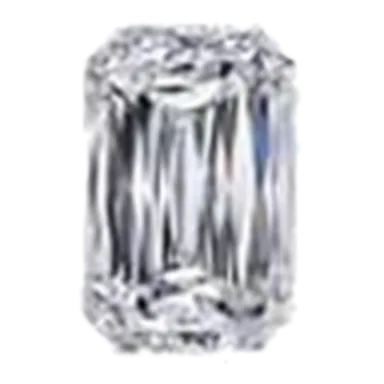
Cross the facets on a step cut and you get something the plain version cannot do. The criss cut runs its facet rows diagonally across each other instead of parallel to the girdle, which produces a lattice of light across the table rather than the corridor of mirrors an emerald cut gives you.
The practical benefit shows up in clarity. Crossed facets break up the field of view, so inclusions that would sit exposed under an emerald cut table get chopped into pieces and stop reading. That makes criss cuts an efficient buy for a jeweler who wants step cut character without paying step cut clarity prices.
This is a small shelf by design and a real one by count: 120 stones, all lab-grown. The outline is usually rectangular with cut corners, occasionally oval. Both belong to the same style and both are represented in stock.
Buying Criss Cut Diamonds Wholesale
The crossing pattern is what you are buying, so check it is actually there. Look straight down at the table in a face-up image and confirm the facet rows meet at angles rather than running parallel. Some stones listed under this name are ordinary emerald cuts with slightly modified corners, and they will not behave the same way in the piece.
Clarity tolerance is genuinely higher than in a plain emerald cut, but do not treat it as unlimited. A dark crystal directly under the center of the table still shows through the lattice. Read the plot for centered inclusions and let the edges of the stone carry whatever the grade allows.
Symmetry is the hard part in this cut. Crossed rows on both sides of the stone have to meet at consistent angles, and any drift shows as a warped pattern rather than as a slightly off measurement. Compare left half to right half in the image before you look at anything else.
The whole shelf is lab-grown, nearly all with IGI reports. Because the shape depends on pattern rather than on outline, matching two stones by eye is harder than in an emerald cut, so start from a matched pair if the design needs two.
Length-to-Width Ratio
Rectangular criss cuts commonly run 1.30 to 1.60 length to width, similar to an emerald cut.
Longer stones show the crossing pattern better because there is more table area for the lattice to develop, so favor the upper half of that range when the client is choosing on look rather than on finger fit.
Frequently Asked Questions
What is a criss cut diamond?
A criss cut is a step cut whose facet rows cross each other diagonally instead of running parallel to the girdle. The result is a lattice pattern across the table and more light activity than a standard emerald cut. Outlines are usually rectangular with cut corners.
Does a criss cut hide inclusions better than an emerald cut?
Yes, noticeably. The crossed facets break up the open field that makes an emerald cut so unforgiving, so a well placed inclusion that would be visible in an emerald cut can disappear in a criss cut. A dark crystal directly under the center of the table is still visible, so read the plot rather than relying on the pattern alone.
Are criss cut diamonds available lab-grown?
Yes, and our full shelf of 120 stones is lab-grown. There is no meaningful natural production in this style at wholesale scale. Each stone links to its own report, and nearly all of them are graded by IGI.
How do I buy criss cuts at trade prices?
Register a free trade account and prices appear on every listing when you sign in. This is a small shelf that turns over, so if you need a specific size and ratio and cannot see it live, call us and we will tell you what is coming.
Related Shapes
Related reading: our diamond buying and grading guides.