Wholesale, Lab-Grown
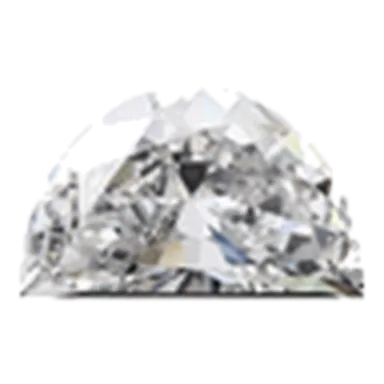
Wholesale Half Moon Diamonds
Natural and lab-grown are two separate lines here, never mixed on one certificate or one price list.
One straight edge, one curve. The half moon is the side stone that softens a ring instead of sharpening it, which is why it pairs so well with round, oval, and cushion centers where a hard-edged trapezoid would fight the outline.
Almost none of these sell as singles. A half moon is bought in twos, matched to each other and fitted to a center stone, and the person buying is usually a custom house or a setter working from a client's drawing. That makes measurement accuracy more important than any grading detail.
Over 130 half moons are in stock and every one of them is lab-grown. Both step-cut and brilliant faceting are represented so the sides can be matched to the character of the center. Matched pairs are available and are how most of this shelf moves.
Buying Half Moon Diamonds Wholesale
The straight edge is the fitting dimension. It has to match the width of the center stone where the two meet, or the ring will show a gap that no amount of metal can hide gracefully. Depth is the second number: the half moon's table needs to finish level with the center's, which usually means a shallower stone than you would pick for a solitaire.
Judge the arc. The curve should be a smooth, even half circle, and the two ends of the straight edge should meet the curve at the same angle. A lopsided arc is obvious once the stone is set next to its mate, and it is the most common defect in cheap half moons.
Pick faceting to match the center. Brilliant-cut half moons belong next to rounds, ovals, and cushions. Step-cut half moons belong next to emerald cuts and asschers. Getting this wrong makes the sides look flat and lifeless, which is the complaint we hear most often about mismatched side stone jobs.
Everything on this shelf is lab-grown and nearly all of it carries IGI reports. Buy the pair rather than two singles. A matched pair is already agreed on arc, straight-edge length, depth, and color, and matching those four things across two separate stones by hand is a long afternoon.
Frequently Asked Questions
What is a half moon diamond?
A half moon is a diamond cut with one straight edge and one curved edge, forming a half circle. It is used almost exclusively as a side stone flanking a center diamond, where the straight edge sits against the center and the curve follows the line of the ring.
How do I size half moons to a center stone?
Match the straight edge to the width of the center stone at the point where they meet, and match depth so the tables sit level. Carat weight is not the right measure here. Send us the center stone's measurements and the mounting style and we will pull half moons that actually fit.
Should half moons be brilliant cut or step cut?
Match the center. Brilliant-faceted half moons sit correctly next to rounds, ovals, and cushions, step-cut half moons belong with emerald cuts and asschers. A step cut against a brilliant center looks dull, and the mismatch is more visible in side stones than anywhere else in a ring.
Are half moon diamonds available in natural?
Not from us. All over 130 half moons we carry are lab-grown, which is the practical reality across nearly every calibrated side stone shape today. Natural half moons exist in the estate market but not in matched pairs at consistent sizes.
How do I order half moons wholesale?
Create a free trade account to see prices, then call with your center stone's dimensions if the stones need to fit a specific piece. We pull and compare side stones here before shipping, which saves a return when a tenth of a millimeter matters.
Related Shapes
Related reading: How matched pairs are actually matched.