Wholesale, Lab-Grown
Wholesale Trillion Cut Diamonds
Natural and lab-grown are two separate lines here, never mixed on one certificate or one price list.
Triangles do two jobs in this business. Flanking a center stone they give a three stone ring a wider, flatter look than trapezoids do. Standing alone in a bezel they read as one of the boldest shapes a designer can put on a hand. The trillion covers both.
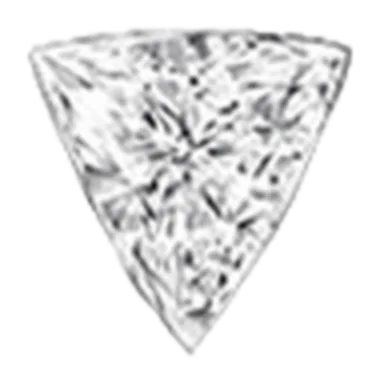
What separates a trillion from a plain triangle is the sides. A trillion is cut with slightly convex edges and brilliant faceting, which softens the outline and pushes more light back out of the stone. We track the two as separate categories, because a designer asking for straight edges will not accept a curved one.
Nearly 200 trillions are on the shelf, effectively all lab-grown. Sizes run from small accent stones through center-stone weights. Since most trillion work needs two matching stones, the depth of the shelf is what makes it usable rather than the headline count.
Buying Trillion Diamonds Wholesale
The three points are thin and they chip. This is the shape most often returned with damage from setting, and the cause is almost always a sharp corner meeting a hard prong. Check the plot for existing chips at the corners, insist on a girdle that is not extremely thin at the points, and use a setter who bezels or corner-prongs rather than one who improvises.
For side stone work, buy on the long edge. That edge sits against the center stone and it has to match its width. Depth matters just as much, since a side stone that sits too high or too low ruins the line of a three stone ring. Send us the center stone's measurements and we will pull against them.
Look at how the sides curve. Trillion sides run from nearly straight to noticeably convex, and that curve changes the personality of the stone completely. Two stones described identically on paper can look like different shapes side by side, so compare face-up images before matching a pair.
The shelf is lab-grown and graded almost entirely by IGI. Matched pairs are the sensible way to buy for three stone work, and every pair we hold is lab-grown. A pair is already agreed on edge length, depth, and curve, which are three things you would otherwise be matching by hand.
Frequently Asked Questions
What is the difference between a trillion and a triangle cut diamond?
Trillions have slightly curved sides and brilliant faceting, triangle cuts have straight sides. The difference is visible when the two are placed next to each other and it matters in design, since a straight-edged triangle sits flush against another straight edge and a trillion does not. We list them as separate shapes for that reason.
Do trillion cut diamonds chip easily?
The three corners are the risk, not the body of the stone. Most damage happens during setting rather than during wear. Buy stones without existing chips on the plot, avoid extremely thin girdles at the points, and have them bezel set or corner-prong set by someone who has done it before.
Can I get matched pairs of trillions for a three stone ring?
Yes, and pairs are the better buy for that job. Every matched pair in stock is lab-grown and already matched on edge length, depth, color, and side curvature. Building a pair from two singles means matching all four of those yourself, which usually costs more in time than the pair premium.
Are natural trillion diamonds available?
Our trillion shelf is lab-grown. Natural triangular brilliants exist but not in the depth or matched-pair supply that side stone work requires, so we do not represent this shape as a natural line. If a client needs a natural side stone, call us and we will tell you honestly what is realistic.
How do I buy trillions wholesale?
Register for a free trade account and prices appear on every listing once you log in. For side stone orders, calling is faster than filtering, because we can match the pair against your center stone's measurements before anything ships.
Related Shapes
Related reading: How matched pairs are actually matched.